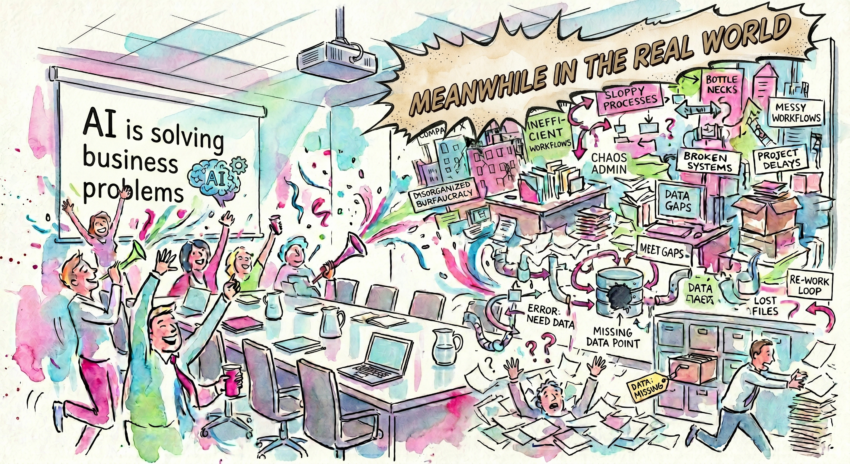
At a conference last week I watched a product do in a couple of minutes what a marketing team would have spent a fortnight on. It felt like watching a magician work the room, pulling the audience in until the impossible was materialised.
I work in an AI team and use these tools every day, so I watch these demos from a slightly different bubble. I know how much unglamorous work sits behind a vibe-coded MVP going live, and I know what AI is good at and what it isn’t.
AI is going to change the shape of work. No one’s really arguing about that anymore. What we’re all still working out is how to actually start.
Here are some of my thoughts on how I would approach AI if I were to start today:
It starts at the top. The organisations getting real value from AI tend to have genuine executive sponsorship, and they make it safe for teams to try, test and fail. The Enterprise AI Playbook, a Stanford study of 51 successful deployments, found that the effective ones “clear blockers weekly, bridge business and technical teams, and tie AI adoption to corporate OKRs. Most critically, they create a culture that gives permission to fail.”1 Failing is essential because AI is unpredictable. Its capabilities are a jagged frontier, strong at one task and surprisingly weak at a near-identical one, and the only way to find the edges is to try things that won’t work.2 And for that reason, ownership and a tolerance for failure matter because they move a company past the innovation-lab theatre and the well-meaning experiments into something tangible: AI woven into how the business actually operates, rather than a pile of pilots that never add up to anything.
Get crystal clear on the vision first. You should be able to draw a line from what the business is trying to achieve, down through its strategy, to the daily tasks people actually do, and only then ask where AI helps. Without that line, AI becomes an innovation experiment: departments build fun little prototypes that get shelved within a month. A clear vision does the opposite. It shows people that AI is there to accelerate how they already work, and even to do things that weren’t possible before. It reinforces that the company is adopting AI to serve the strategy, not to chase a buzzword.
Make it safe to use. If AI is sold as the thing that strips out low-value work but quietly piles more onto people, or worse, as the reason they’ll be made redundant, no one will tell you how their job actually works. And that knowledge is exactly what you need to deploy it well. A recent Harvard Business Review piece on stalled adoption found the same thing: right now the headwinds beat the tailwinds.3 People are wary of AI in general, afraid of losing their jobs to it, of breaking some half-written company policy, or of looking like they’re cheating. So organisations have to get the messaging right. Force AI on people before you’ve figured this out, and they’ll find a way to game it, doing the bare minimum to tick the box without ever getting real value. As Peter Senge put it, “people don’t resist change, they resist being changed”. The thing people are made to do becomes the very thing they avoid. Get it right, and people show you how the work really gets done.
A bad process is still a bad process, even with AI on top. You’ve just made it faster. AI won’t fix a broken workflow; it scales it. The same Stanford study found that “77% of the hardest challenges were invisible and intangible costs: change management, data quality, and process redesign. 61% of successful projects included at least one prior failure, whose costs never appear in the final ROI.”4 So before you add anything, the real work is rethinking whether the way you solve a problem is even the right way to solve it. The hard part is the unglamorous part: process documentation and data architecture, and getting those right is what lets AI scale once it goes on top. Holweg and Davenport describe what happens when AI slop spreads through a company’s processes: errors pile up, outputs degrade, and, in their words, “trust in information erodes,” until people stop trusting the very processes they rely on to do their jobs.5
Get educated. Leaders need to understand what AI actually is, enough to walk into a demo and know what they’re looking at. I recently watched different companies, at different events, essentially selling an MCP as a service. Only if you know what it is and takes to build, can you judge what it would take to build yourself, and what the shiny version is really worth. There are good, free resources from the likes of Anthropic, Microsoft and Google. Don’t get hung up on which specific tools they use; it’s about building an understanding of the context and the make-up of AI. It’s like any other discipline: a thing to learn and get comfortable with, not a magic box to outsource your judgement to.
So what next? The demos really are impressive, and many of them are worth it. But the people who’ll actually get somewhere aren’t the ones who buy the fastest. They’re the ones who go home, fix the process, get the data in order, and work out what they actually want from AI before they pay for it. I don’t think anyone has it fully worked out yet, me included and that’s the exciting part.
- Elisa Pereira, Alvin Wang Graylin and Erik Brynjolfsson, The Enterprise AI Playbook: Lessons from 51 Successful Deployments (Stanford Digital Economy Lab, April 2026), https://digitaleconomy.stanford.edu/publication/enterprise-ai-playbook/. ↩︎
- Dell’Acqua et al., “Navigating the Jagged Technological Frontier” (HBS Working Paper No. 24-013, 2023). ↩︎
- Marc Zao-Sanders, “How People Are Really Using AI in 2026,” Harvard Business Review, 1 June 2026, https://hbr.org/2026/06/how-people-are-really-using-ai-in-2026. ↩︎
- Elisa Pereira, Alvin Wang Graylin and Erik Brynjolfsson, The Enterprise AI Playbook: Lessons from 51 Successful Deployments (Stanford Digital Economy Lab, April 2026), https://digitaleconomy.stanford.edu/publication/enterprise-ai-playbook/. ↩︎
- Matthias Holweg and Thomas H. Davenport, “Don’t Let AI Slop Muck Up Your Company’s Processes,” Harvard Business Review, 16 June 2026, https://hbr.org/2026/06/dont-let-ai-slop-muck-up-your-companys-processes. ↩︎