On imitation, effort, and slop
It is a truth universally acknowledged that great art is copied. Anyone who studies literature, music, or any other creative form understands that no work arrives from nowhere. Michelangelo copied the Romans, and Raphael copied Michelangelo. Without Shakespeare’s Romeo and Juliet there would be no West Side Story. The artists worth remembering have always known this and said so plainly. William Blake held that the difference between a good artist and a bad one is that “the bad artist seems to copy a great deal, the good one really does”. T.S. Eliot put it more provocatively: “Immature poets imitate; mature poets steal”. Both emphasise that there is a right and a wrong way to copy.
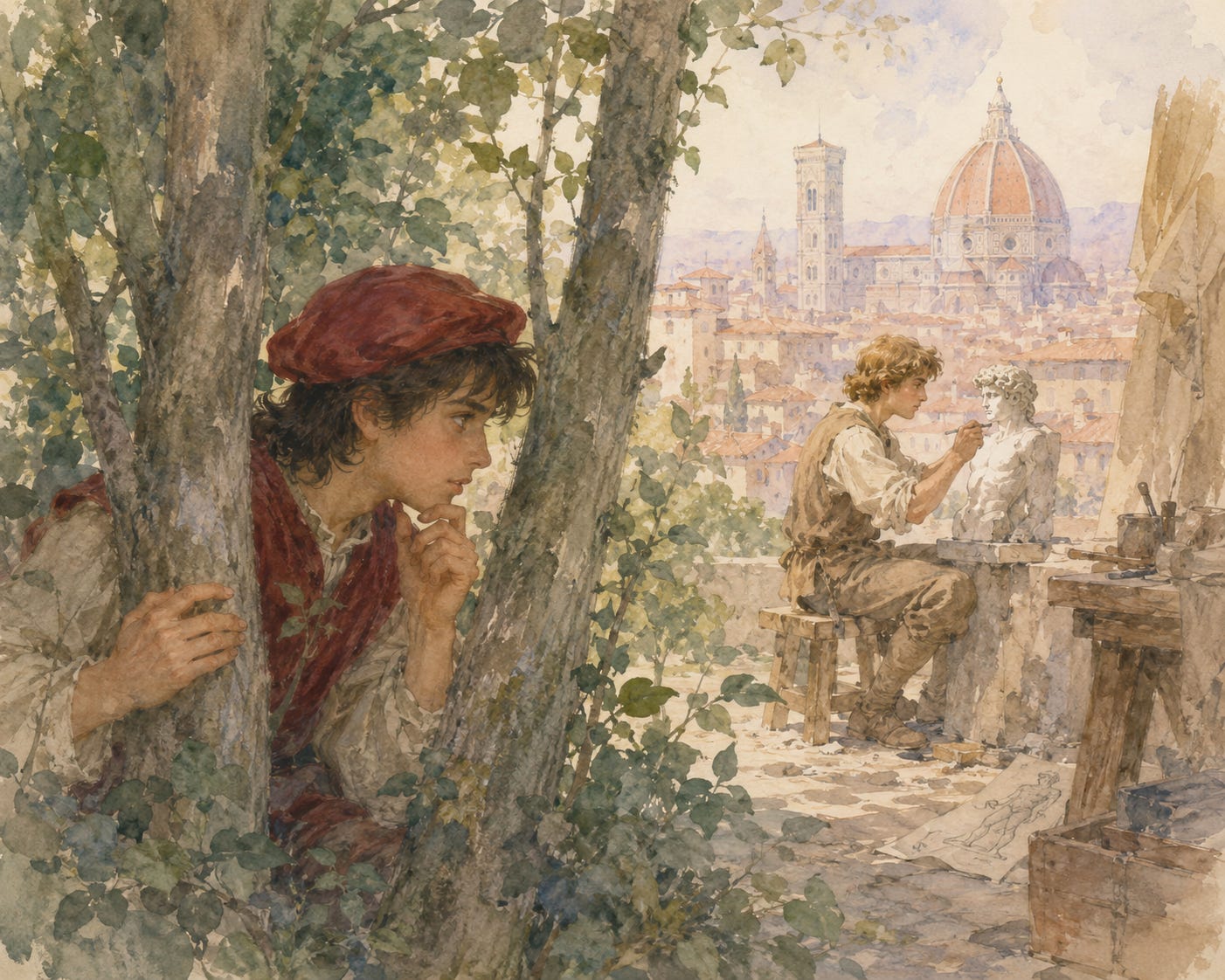
If art has always involved imitation, then I wonder if AI simply is the greatest imitator humankind has produced, an imitator that was never itself human? AI is trained on more text and images than any person could absorb in a hundred lifetimes, honed on the work of living and dead artists, and refined against every art form we have ever made.
I’ve been pondering why AI has provoked such a visceral reaction and I’ve been wondering if it has something to do with the effort that art takes. To copy a great artist means pouring time, patience and craft into the work; AI strips that away. It lowers the bar for producing something that looks passable. Anyone untrained in a craft can now produce a competent-sounding paragraph, a good-enough tune, or a passable illustration. The result is a new form of content: AI slop, gooey, gelatinous uniformity. It is like soup. Each spoonful holds different bits, yet every spoonful tastes the same.
When DALL-E 2 arrived in 2022, its output was unmistakably artificial. The images carried tells: warped hands, lettering that spelled gibberish. Those markers made the pictures almost cute, quaint even, nothing you would mistake for human craft. They were a genre of their own and became recognisable at a glance. Four years on, the tells are gone. AI has become good enough, and woven deeply enough into how everyone works, that it no longer announces itself at all. But the tells did not vanish so much as change. The old signature was strangeness; the new one is sameness. You can watch it play out in writing. First the em dash, then the “not just X, but Y” construction, then the relentless rule of three. Each one gets noticed, it gets called out, avoided and replaced by another AI-ism.
We associate effort with good art, so when effort vanishes, what is left?. But effort was never the thing itself. It is the cost of copying well, not the point of it. Through copying we do not reproduce, we transform: we recognise the original, argue with it, shape it until it becomes our own. Raphael did not merely copy Michelangelo. He studied him until he understood what he was doing, then laid his own way of seeing over the top until the borrowing was unmistakably his. That is what effort was always standing in for, not the labour, but the transformation the labour made possible.
So slop is not a question of effort at all. It is what comes out when nothing is transformed, when AI is used as a vending machine: input in, output out. Used the other way, as a medium to push against and challenge to a point of view, AI does not produce sameness.